Few milestones are as exciting — or as nerve-wracking — as your toddler learning to walk and climb. And few hazards cause as many home injuries as the staircase. Good stair safety for toddlers comes down to a few reliable barriers and a couple of simple habits. Get those right and you remove one of the biggest fall risks in your home.
Why toddlers are at peak stair-fall risk
A newly-walking toddler is the perfect storm: mobile enough to reach the stairs, curious enough to want to climb them, and far too young to judge the danger. They are top-heavy, unsteady on their feet, and often more confident than their balance allows. Stairs become an irresistible challenge, and a single missed step can mean a serious fall. This is exactly the stage to act — before a near-miss becomes an injury.
Falls are one of the most common reasons young children end up in casualty, and stairs are among the worst offenders because a fall down several hard steps carries real force. The reassuring news is that almost all of these falls are preventable with a couple of well-placed barriers — you don't need to redesign your home, just block the access.
Gate the top and the bottom
The single most effective step is a safety gate at both ends of the staircase. The bottom gate stops your toddler starting an unsupervised climb. The top gate is even more important — and it must be a securely-mounted safety gate, not a loose pressure-fit. A pressure-mounted gate at the top of stairs can be pushed loose by a falling child, which is the worst possible moment for it to give way. Choose a gate that fixes firmly in place for that top position.
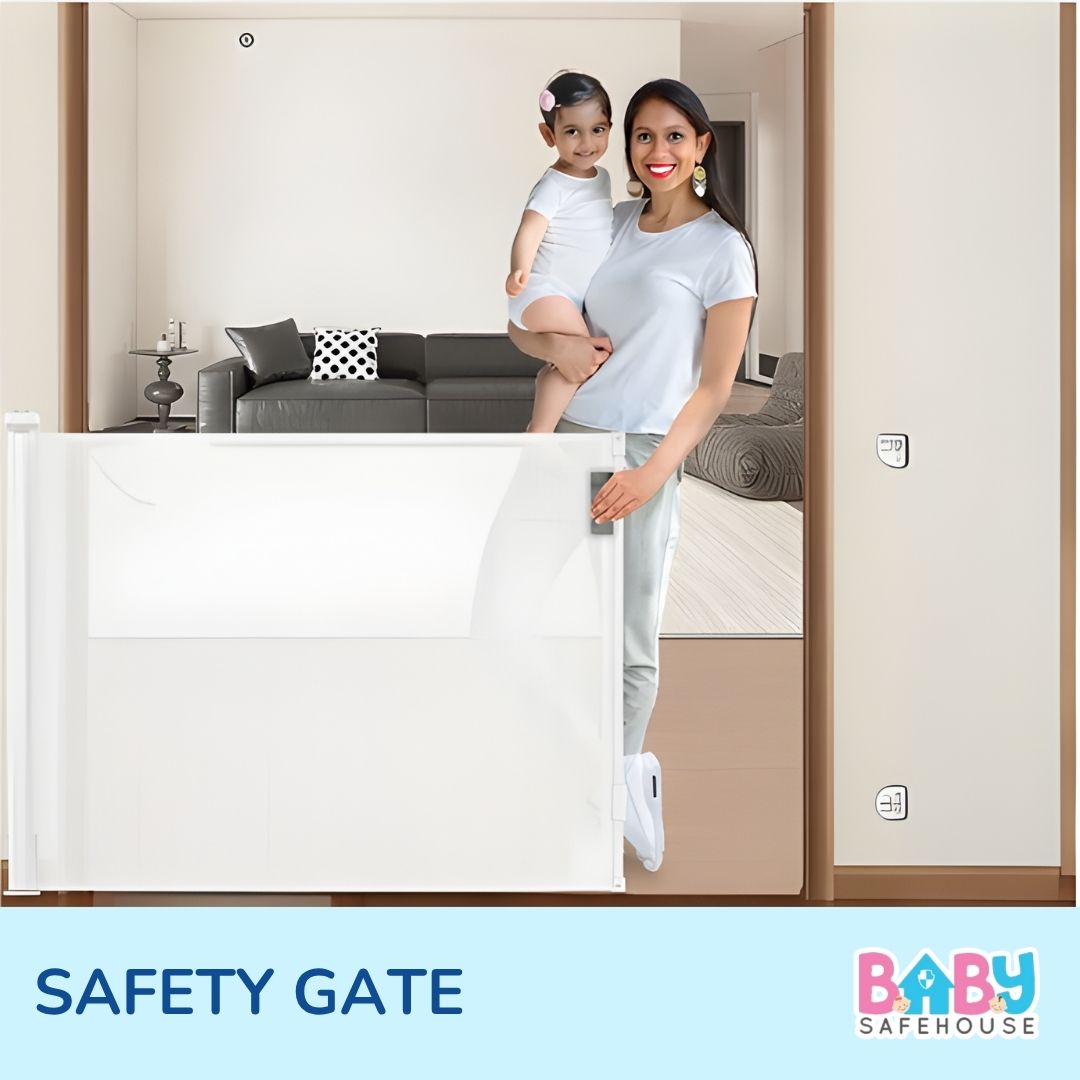
In many Indian homes with odd doorway widths or narrow landings, a retractable or width-adjustable gate is the most practical choice because it fits awkward openings and folds away when not needed.
Close the gaps and add grip
- Wide banister gaps are a hazard of their own — fit safety netting along the railing so little limbs and heads can't slip through.
- Add non-slip strips to the edge of each step, especially on smooth stone or tiled stairs.
- Make sure the stairwell is well lit so older toddlers can see each step clearly.
Indian stair specifics worth noting
Indian staircases bring particular challenges. Marble and granite steps are beautiful but hard and slippery, so a fall does more damage and grip strips matter more. Open spiral staircases in duplexes have gaps that need netting. And handrails are usually built for adults, sitting far too high for a toddler to hold — another reason gates and supervision do the real work at this age.
Teach safe climbing, with supervision
Gates are not a substitute for teaching. Once your toddler is steady, supervise short practice sessions where you show them to come down backwards, on their tummy, feet first — the safest way for little ones. Always stay just below them. The goal is a child who eventually handles stairs confidently, with the gates as the safety net until then.
How to choose the right gate for stairs
Not every gate suits every spot. For the top of the stairs, prioritise a firmly fixed gate with a reliable latch your toddler can't work out. For the bottom and for doorways, a width-adjustable or retractable gate gives you flexibility, especially in flats where openings rarely match standard sizes. Look for a smooth one-handed latch (you'll often be holding the baby), a double-lock mechanism, and a width range that actually fits your opening — measure before you buy. A gate that's annoying to use is a gate that gets left open, so ease of use is a safety feature, not a luxury.
When can you remove the gates?
There's no single age — it depends on the child. Most families keep stair gates until around 2 to 3 years, once the toddler reliably climbs up and down under supervision and can be trusted not to rush. Remove the top gate last.
Quick stair-safety checklist
- Securely-mounted gate at the top of the stairs.
- Gate at the bottom of the stairs.
- Netting over wide banister gaps.
- Non-slip strips on every step.
- Good lighting in the stairwell.
- Supervised practice climbing down feet-first.
A baby safety gate designed for Indian doorways and stairs is the foundation of all of this. Secure the top and bottom first, add netting and grip, and you've handled the home's biggest fall risk.